
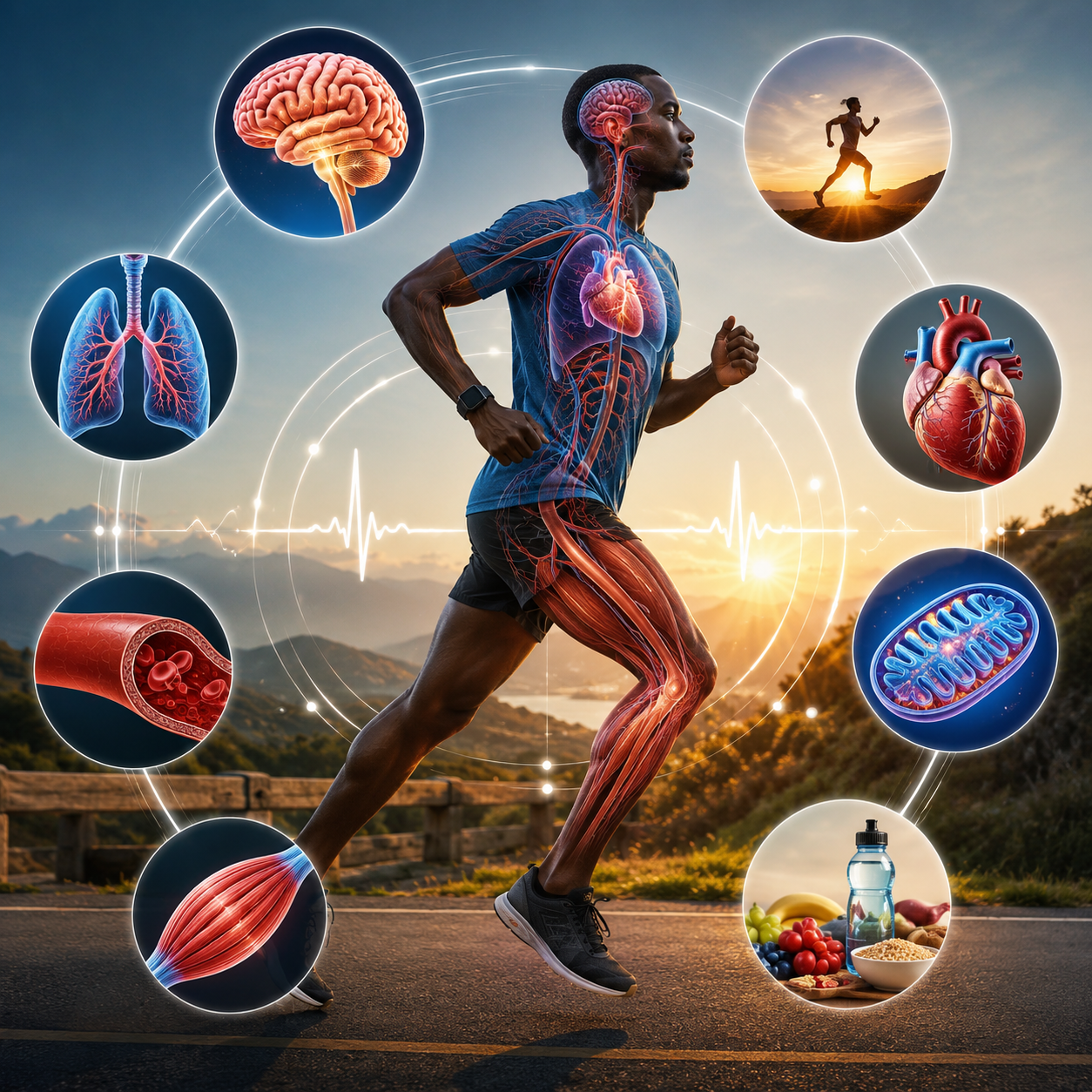
Running has become one of the most popular forms of exercise in Zambia. Every day, thousands of people take to the streets, parks, and trails in preparation for their next 5 km, 10 km, half-marathon, or marathon event.
Many runners spend hours thinking about training plans, running shoes, nutrition, hydration, and race strategies. Yet surprisingly few understand what is actually happening inside their bodies during exercise.
How does your heart know it needs to beat faster?
Why does your breathing increase?
What causes you to sweat?
How do your muscles know they need more oxygen?
And perhaps most importantly, how does your body coordinate all of these changes within seconds of starting a run?
The answer lies within one of the most remarkable control systems in the human body: the nervous system.
Entire textbooks have been written about exercise physiology, but in this article I will break down some of the key concepts into simple, practical language that every runner can understand.
Welcome to the Exercise Physiology Series
Whether you're training for your first 5 km, preparing for a marathon, cycling on weekends, or simply trying to improve your health, understanding how your body responds to exercise can help you train smarter and recover better.
Many people spend years exercising without ever learning what is happening beneath the surface. They know their heart rate goes up, their breathing becomes faster, and their muscles become tired, but few understand why these changes occur or how the body coordinates such a remarkable response.
The human body is an extraordinary machine. Every time you go for a run, ride a bicycle, swim, or walk briskly, multiple systems work together simultaneously.
Your nervous system, heart, lungs, muscles, hormones, blood vessels, and metabolism all communicate continuously to ensure your body can meet the demands of exercise.
The goal of this series is to explain the science of exercise in simple, practical language that anyone can understand. You don't need a medical degree or exercise science background to appreciate the fascinating processes taking place inside your body.
In this first article, we will explore what happens inside your body when you begin exercising. An introduction to one of the most important control systems in human physiology: the Autonomic Nervous System.
In future articles, we will dive deeper into topics such as:
The Autonomic Nervous System and Exercise – Understanding the body's accelerator and brake systems, and why balancing training with recovery is critical for long-term health and performance.
Heart Rate Zones Explained – What different heart rate zones mean and how they relate to energy production. By understanding this concept you can train more efficiently to improve fitness.
How Your Body Produces Energy – Understanding ATP, carbohydrates, fats, and why different exercise intensities use different fuel sources.
The Aerobic and Anaerobic Systems – Why easy runs feel different from hard intervals and what happens when you push beyond your aerobic capacity.
VO₂ Max and Endurance Performance – What VO₂ Max actually measures and why it is often considered one of the best indicators of cardiovascular fitness.
Lactate and the Lactate Threshold – Debunking common myths and explaining why lactate is not simply a waste product.
Training Adaptation and Recovery – How fitness is built, and why recovery matters. What happens when training exceeds the body's ability to recover.
Overtraining and Burnout – Understanding the warning signs when the body's stress systems become overwhelmed.
Exercise and Longevity – Exploring how regular physical activity influences heart health, brain function, metabolic health, and lifespan.
By the end of this series, you'll have a much better understanding of how your body works during exercise and how to use that knowledge to improve performance, reduce injury risk, and support long-term health.
So let's start at the beginning and explore what happens inside your body the moment you take that first step on a run.
Meet Your Autonomic Nervous System
Most people are familiar with the brain and spinal cord, but fewer have heard of the Autonomic Nervous System (ANS).
The word "autonomic" simply means automatic.
This system regulates many of the functions that keep you alive without you having to think about them.
Your heart beats automatically and your lungs breathe automatically whilst your blood pressure, digestion, body temperature, and circulation are all regulated automatically.
The Autonomic Nervous System has two major divisions:
The Sympathetic Nervous System, often called the "fight or flight" system, prepares the body for action.
The Parasympathetic Nervous System, often called the "rest and digest" system, helps the body recover, repair, and conserve energy.
These two systems are constantly working together like the accelerator and brake pedals in a car.
Good health depends on maintaining a healthy balance between the two.
The Moment You Start Running
Imagine you are standing at the start line of a race.Even before you begin moving, your body starts preparing for exercise.
Your brain anticipates the upcoming effort and sends signals to activate the sympathetic nervous system. Within seconds, stress hormones such as adrenaline begin circulating through your bloodstream.Your heart rate starts to rise.
Blood vessels supplying your muscles begin to open.
Breathing becomes deeper.
Blood flow is redirected away from less urgent functions such as digestion and toward the muscles that will soon need extra oxygen.
All of this occurs before you have even taken your first stride.Your body is essentially preparing for battle.
Your Heart Becomes a High-Performance Pump
One of the most noticeable changes during exercise is the increase in heart rate.
At rest, your heart may beat between 60 and 80 times per minute. During exercise it may rise to 120, 140, 160 beats per minute or even higher, depending on your age, fitness level, and exercise intensity.
Why?
Because your working muscles require more oxygen and nutrients.
The heart responds by pumping more blood with each beat and increasing the number of beats per minute. This allows more oxygen-rich blood to reach the muscles and more waste products, such as carbon dioxide, to be removed.
The fitter you become, the more efficient this system becomes.
This is one reason endurance athletes often have lower resting heart rates than sedentary individuals.Their hearts have become stronger and more efficient pumps.
Your Lungs Join the Team
As your muscles work harder, they consume more oxygen and produce more carbon dioxide.
To keep up with this demand, your breathing rate increases.
You may notice that during an easy run you can comfortably hold a conversation. As intensity increases, speaking becomes more difficult because your body is prioritising breathing.
This is one reason many coaches use the "talk test" as a simple way to gauge exercise intensity.Your lungs and cardiovascular system are working together to deliver oxygen where it is needed most.
Your Muscles Demand More Energy
Muscles are like engines. They require fuel to produce movement.
The body's preferred energy source during exercise is a molecule called ATP (adenosine triphosphate).
The challenge is that your body stores only a small amount of ATP. To keep you moving, it must continuously produce more.
Depending on exercise intensity, the body can manufacture ATP from carbohydrates, fats, and in some situations, proteins.
During easy aerobic exercise, much of the energy comes from fat metabolism.
As intensity increases, the body relies increasingly on carbohydrates because they can provide energy more rapidly.
This is one reason runners often "hit the wall" during long races if they run out of available carbohydrate stores.
Why You Sweat
Many runners assume sweating means they are losing weight or becoming fitter.
In reality, sweating is primarily a cooling mechanism.
Approximately 75% of the energy produced by muscles is released as heat rather than movement.
Without an effective cooling system, body temperature would rise rapidly during exercise.
Sweat evaporates from the skin and helps dissipate excess heat. This allows the body to maintain a relatively stable internal temperature even during prolonged exercise.
Fitness Is Adaptation
Perhaps the most fascinating aspect of exercise physiology is the body's ability to adapt.
Every run places a small amount of stress on the cardiovascular system, muscles, lungs, nervous system, and metabolism.
Provided adequate recovery occurs, the body responds by becoming stronger and more efficient.
The heart pumps more effectively.
The muscles become better at using oxygen.
The body develops more blood vessels.
The nervous system becomes more coordinated.
This process is known as adaptation, and it is the reason consistent training leads to improved fitness.
The Role of Recovery
Many runners believe fitness is built during training.
This is only partly true.
Training provides the stimulus for improvement, but adaptation occurs during recovery.
When you rest, sleep, eat well, and allow the body time to repair itself, the physiological changes that improve performance take place.
Without adequate recovery, the body can become trapped in a state of fatigue and excessive stress.In many ways, recovery is where fitness is truly built.
Final Thoughts
The next time you go for a run, take a moment to appreciate the incredible coordination taking place inside your body.
Your brain, nervous system, heart, lungs, muscles, hormones, and blood vessels are all working together to keep you moving.
What feels like a simple jog around the block is actually one of the most complex and impressive physiological processes in the human body.
In the next article in this series, we'll take a deeper look at the Autonomic Nervous System and explore why understanding your body's "accelerator" and "brake" may be one of the most important concepts for improving performance, recovery, and long-term health.
Want to learn more about running, recovery, injury prevention and performance?
For more in depth information regarding exercise physiology, click the link below
Further Reading: Kenney WL, Wilmore JH, Costill DL. Exercise Physiology: Physiology of Sport and Exercise. National Center for Biotechnology Information (NCBI).




1 Comment