
"You're stressed." It's a phrase we hear almost every day yet few people understand the silent health threat behind stress. We use it to describe everything from a busy work schedule to financial worries, relationship challenges, traffic jams, or even preparing for an important event.
But what exactly is stress?
Most people think stress is simply an emotion or a feeling of being overwhelmed. In reality, stress is much more than that. Stress is a complex physiological response that affects virtually every system in the body. Understanding how stress works may be one of the most important steps you can take toward improving your health and wellbeing.
What Is Stress?
Stress is the body's natural response to a challenge, demand, or perceived threat. It is a survival mechanism that has helped humans stay alive for thousands of years.
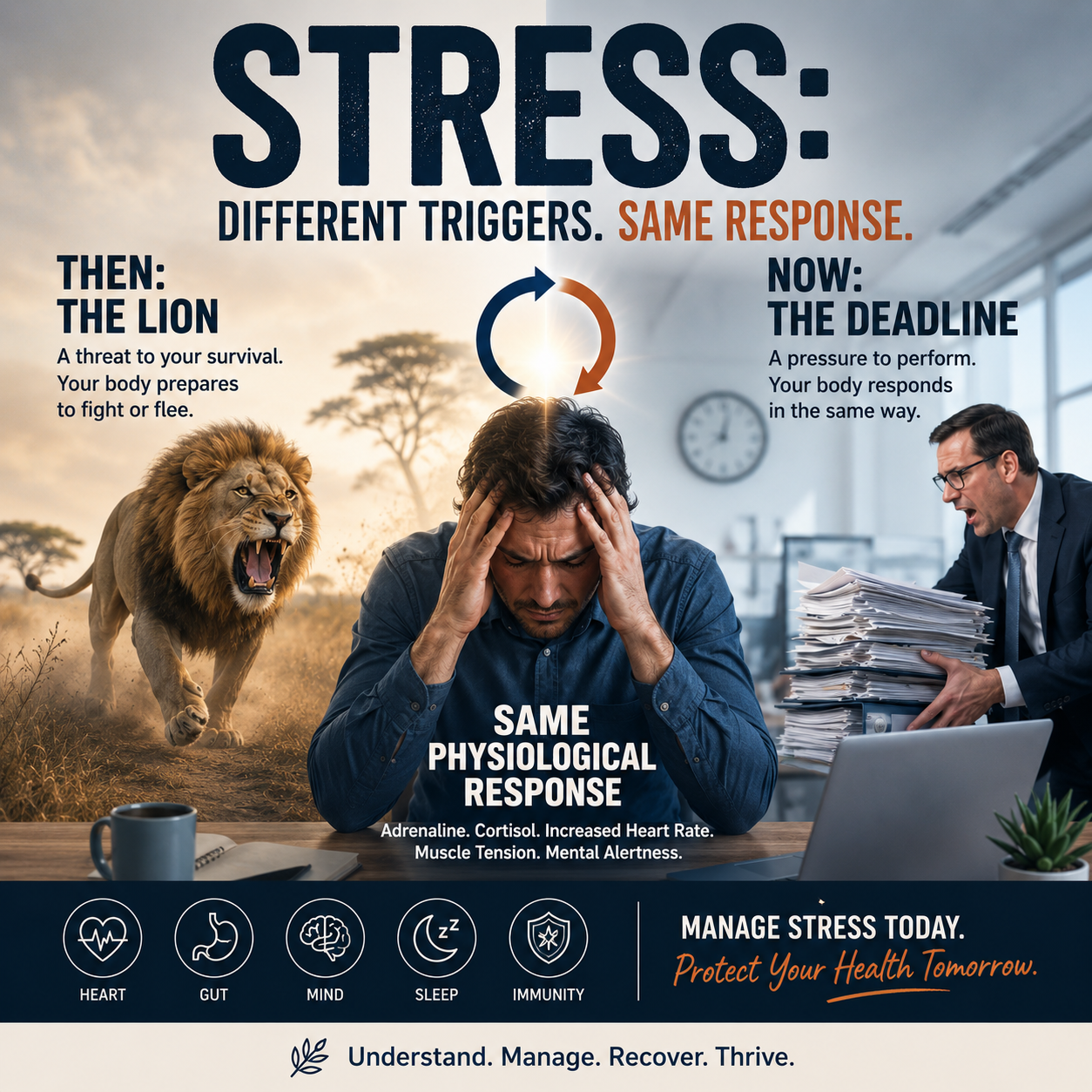
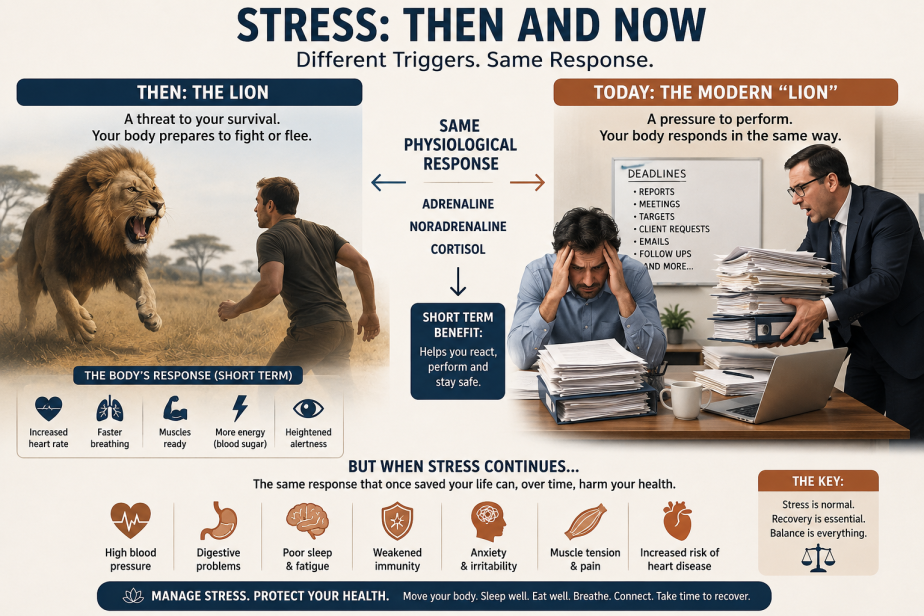
Imagine one of our ancestors encountering a lion on the African savannah. The body instantly needed to decide whether to fight, flee, or freeze. Within seconds, hormones were released, heart rate increased, muscles became tense, breathing accelerated, and blood flow was redirected to the areas needed for survival.
This is known as the "fight-or-flight" response.
The problem is that while lions are rare today, our bodies often respond to modern stressors in exactly the same way.Your brain cannot always distinguish between a charging predator and:
To your nervous system, stress is stress.
Not All Stress Is Bad
When most people hear the word "stress," they immediately think of something negative. However, stress itself is not inherently harmful. In fact, a certain amount of stress is essential for life. Without it, we would lack the motivation to learn, grow, achieve goals, or even perform everyday tasks.
Health professionals often distinguish between two types of stress: eustress and distress. Understanding the difference is important because not all stress affects the body in the same way.
Eustress: The Stress That Helps Us Grow
Eustress is often referred to as "positive stress." It is the type of stress that challenges us without overwhelming us. When we experience eustress, the body becomes alert, focused, and energized. Rather than feeling threatened, we feel motivated.
Think about some of the major milestones in life. Starting a new job, preparing for an important sporting event, getting married, learning a new skill, or studying for an examination can all create stress. Yet these experiences are often associated with excitement, personal growth, and achievement.
Exercise provides one of the best examples of eustress. Every time you lift a weight, go for a run, or challenge yourself physically, you are placing stress on your body. In response, the body adapts by becoming stronger, fitter, and more resilient. Without that stress, improvement would never occur.
In many ways, eustress acts like a personal trainer for both the mind and body. It encourages adaptation, growth, and progress. A healthy level of challenge is an important part of maintaining physical health, mental sharpness, and emotional resilience.
Distress: When Stress Becomes Harmful
Problems arise when stress becomes excessive, prolonged, or feels beyond our ability to cope. This is known as distress.
Unlike eustress, which is typically short-lived and followed by recovery, distress can keep the body's stress response activated for days, weeks, months, or even years. The body remains in a state of heightened alertness, constantly preparing for threats that may never actually materialize.
Imagine a zebra being chased by a lion. Once the chase is over, the zebra returns to grazing and its stress hormones quickly return to normal levels. Humans, however, often continue to replay stressful situations in their minds long after the event has passed. An argument with a spouse, concerns about finances, workplace pressures, chronic pain, or uncertainty about the future can keep the body's stress response switched on long after the original trigger has disappeared.
Over time, this constant state of activation begins to take a toll. The very mechanisms that help us survive in the short term can become harmful when activated continuously. Elevated levels of stress hormones such as cortisol and adrenaline may contribute to high blood pressure, digestive disturbances, sleep problems, chronic pain, fatigue, and reduced immune function.
The Importance of Recovery
The key difference between healthy stress and harmful stress is often not the stress itself, but the opportunity to recover.
Our bodies are designed to handle challenges. We are remarkably adaptable and capable of responding to short periods of physical and emotional demand. What the body struggles with is relentless stress without adequate recovery.
Think of stress like sunlight. A small amount is essential for life and health. Too little can be harmful, but too much exposure without protection can cause damage. Stress works in much the same way.
The goal should not be to eliminate stress from life entirely. That would be impossible and, in many cases, undesirable. Instead, the aim is to develop resilience, manage challenges effectively, and ensure there are regular opportunities for rest, recovery, and renewal.
The healthiest individuals are not those who avoid stress altogether. They are often the people who have learned how to balance periods of challenge with periods of recovery.
When Stress Stops Being Helpful
The human stress response is a remarkable survival mechanism. It evolved to help us escape danger, respond to emergencies, and adapt to challenges. In the short term, it can improve focus, increase physical performance, and sharpen our reactions. The problem is that many people today live in a state of chronic stress, where the body never fully returns to a state of recovery.
Imagine driving your car with the accelerator pressed to the floor all day, every day. Eventually the engine would overheat, components would wear out, and performance would begin to suffer. The human body operates in much the same way. While it is capable of handling significant demands for short periods, it was never designed to remain in a constant state of high alert.
Over time, chronic stress can influence almost every system in the body.
Stress and the Heart
One of the first systems affected by prolonged stress is the cardiovascular system. When stress hormones such as adrenaline and cortisol are released, heart rate increases and blood pressure rises. These changes are beneficial during an emergency because they help deliver oxygen and nutrients to the muscles and brain.
However, when stress becomes a daily companion, the heart is forced to work harder for longer periods. Blood vessels remain under increased pressure, inflammation may rise, and the risk of cardiovascular disease can gradually increase.
Chronic activation of the stress response leads to repeated elevations in heart rate, blood pressure, and circulating stress hormones. Over time, these physiological changes may contribute to hypertension, vascular dysfunction, inflammation, and an increased risk of cardiovascular disease.
The heart does not simply respond to physical activity. It also responds to emotional and mental pressures. In many cases, the body reacts to a difficult meeting with the boss in much the same way it would react to a physical threat.
Stress and Digestive Health
Have you ever noticed your stomach becoming unsettled before an important presentation or examination? That is the stress response in action.
The digestive system and the brain are closely connected through what scientists call the gut-brain axis. When the body enters a stress state, digestion is often placed on hold because survival becomes the priority. Blood flow is redirected away from the digestive organs and toward the muscles needed for action.
While this is useful in the short term, prolonged stress can interfere with normal digestive function. Many people living with chronic stress experience symptoms such as bloating, indigestion, reflux, constipation, diarrhoea, or abdominal discomfort. Stress may also alter the balance of beneficial bacteria within the gut, which can further influence digestion, immunity, and overall health.
It is often said that we "feel stress in our stomach," and there is considerable physiological truth behind that statement.
Stress and Sleep
Sleep is one of the body's most important recovery mechanisms. Unfortunately, it is also one of the first areas affected when stress levels rise.
A stressed brain is often a busy brain. Thoughts race, worries become magnified, and relaxation becomes difficult. Even when people manage to fall asleep, they may find their sleep is lighter, less restorative, or interrupted throughout the night.
This creates a vicious cycle. Stress disrupts sleep, and poor sleep increases the body's sensitivity to stress. Over time, this combination can contribute to fatigue, irritability, poor concentration, reduced productivity, and a diminished ability to cope with everyday challenges.
Without adequate sleep, the body loses one of its most powerful tools for recovery and repair.
Stress and the Immune System
Many people have experienced becoming ill immediately after a particularly stressful period. This is not simply a coincidence.
The immune system and the nervous system are closely connected. Short periods of stress may temporarily enhance certain immune responses, but chronic stress tends to have the opposite effect. Persistently elevated cortisol levels can impair immune function, making the body more vulnerable to infections and slowing recovery from illness.
This may explain why some individuals seem to catch every seasonal virus that circulates through the workplace or household during particularly stressful times in their lives.
Supporting the immune system therefore involves much more than taking vitamins. Managing stress, prioritising sleep, and maintaining healthy lifestyle habits are equally important components of long-term immune health.
Stress, Chronic Pain and Muscle Tension
As a chiropractor, one of the most common manifestations of stress I see in practice is increased muscle tension.
When the brain perceives a threat, muscles automatically contract in preparation for action. This response is useful if you need to run, fight, or react quickly. However, when stress becomes chronic, muscles may remain partially contracted for prolonged periods.
This sustained muscle tension commonly affects the neck, shoulders, jaw, and lower back and may contribute to headaches, stiffness, fatigue, and chronic pain syndromes.
Stress does not mean the pain is "all in your head." The pain is very real. Stress simply acts as an amplifier, increasing muscle tension, nervous system sensitivity, and the body's perception of discomfort.
Stress and Cancer
One of the most common questions people ask is whether stress causes cancer.
The relationship is more complex than many headlines suggest.
While there is currently no conclusive evidence that stress directly causes cancer, researchers continue to investigate how chronic stress may influence inflammation, immune surveillance, tumour growth, and treatment outcomes. Chronic stress is increasingly recognised as a factor that may negatively influence overall health and resilience.
Researchers continue to investigate how stress affects inflammation, immune function, hormonal regulation, and lifestyle behaviours. People under chronic stress may sleep poorly, exercise less, consume a less healthy diet, smoke more, or drink excessive amounts of alcohol. These factors can influence health outcomes and may affect disease risk over time.
While stress should not be viewed as a direct cause of cancer, managing stress remains an important part of supporting overall health and resilience.
Learning to Work With Stress
The goal is not to eliminate stress from life. That would be impossible. A certain amount of stress is necessary for growth, achievement, and adaptation. The goal is to develop the ability to recover effectively.
Exercise, quality sleep, healthy nutrition, social connection, time outdoors, relaxation practices, and meaningful hobbies all help shift the body back toward a state of recovery. These activities activate what is often called the "rest and digest" system, allowing the body to repair, rebuild, and restore balance.
In many ways, recovery is where health is created. Stress may stimulate growth, but recovery is what allows that growth to occur.
Final Thoughts
Stress is not the enemy. In fact, it is one of the reasons humans have survived and thrived as a species. The same stress response that helped our ancestors escape predators continues to help us rise to challenges, meet deadlines, solve problems, and pursue our goals.
The problem arises when stress becomes chronic and recovery becomes insufficient. The body begins to pay a price, often affecting the heart, digestive system, immune function, sleep quality, energy levels, and musculoskeletal health.
Perhaps the most important lesson is that stress management is not simply about feeling calmer. It is about protecting your long-term health. By learning to balance periods of challenge with periods of recovery, you can build resilience, improve wellbeing, and give your body the opportunity to function as it was designed to.
After all, it is not the occasional stressful day that causes problems. It is living in a constant state of stress without allowing yourself time to recover.
Don't Wait Until Stress Becomes a Health Problem
Many people ignore the early warning signs of stress until they develop headaches, chronic pain, digestive issues, poor sleep, or fatigue. The good news is that small changes made today can have a significant impact on your future health.
If you're ready to improve your health, reduce pain, and build resilience against life's daily stresses, I'm here to help.