What Chiropractic, Acupuncture, Yoga, Ayurveda and Homeopathy Can Teach Us About Connection, Flow and Wellbeing
Modern medicine has made remarkable advances over the past century. Emergency care, trauma medicine, surgery, diagnostics, infection control and life-saving interventions have changed the world, and many people are alive today because of these developments.
However, there is another side to modern healthcare that deserves honest discussion. Too often, chronic health problems are managed mainly through medication, while not enough attention is given to the deeper factors that may be contributing to the problem. Pain, inflammation, poor sleep, stress, poor posture, lack of movement, poor diet, emotional strain and lifestyle habits are often treated as separate issues, when in reality they are frequently connected.
This article is not written from an anti-medicine perspective. It is written from a whole-body perspective. There is a difference between medicine that saves lives and a healthcare model that can profit from people remaining chronically unwell. When long-term symptoms are managed only with long-term medication, without asking why the body is struggling in the first place, something important is being missed.
Ancient healing traditions may not have had modern imaging, blood tests or surgical technology, but many of them understood something that modern healthcare often overlooks: the body is connected. Pain is not always just pain. Stiffness is not always just stiffness. Fatigue is not always just tiredness. Symptoms often tell a deeper story about how the body is functioning, adapting, compensating and struggling.
Therefore, when we look at chiropractic, acupuncture, yoga, Ayurveda and homeopathy, the goal should not be to pretend they are all the same. They are not. Instead, we can ask a better question: what can these traditions teach us about the whole body?
A Different Way of Looking at Health
Most people are trained to think about health in separate parts. If they have a headache, they take a painkiller. If they have back pain, they take something for the pain. When they cannot sleep, they take sleeping tablets. If they feel anxious, they take something to calm down.
In some cases, medication may be necessary and helpful. However, if the deeper reason for the problem is never explored, the symptom may return again and again. This is where whole-body thinking becomes important, because the body rarely works in isolated compartments.
A headache may be linked to neck tension, jaw clenching, stress, dehydration, poor sleep, eye strain or posture. Back pain may be linked to prolonged sitting, weak stabilising muscles, poor movement patterns, emotional stress, old injuries or lack of recovery. Poor sleep may be linked to pain, screen exposure, nervous system overload, breathing patterns, stress hormones or poor daily rhythm.
In other words, the symptom is often the final warning light. The deeper question is not only, “How do we suppress this symptom?” The deeper question is, “Why is the body struggling?”
The Shared Theme: Connection and Flow
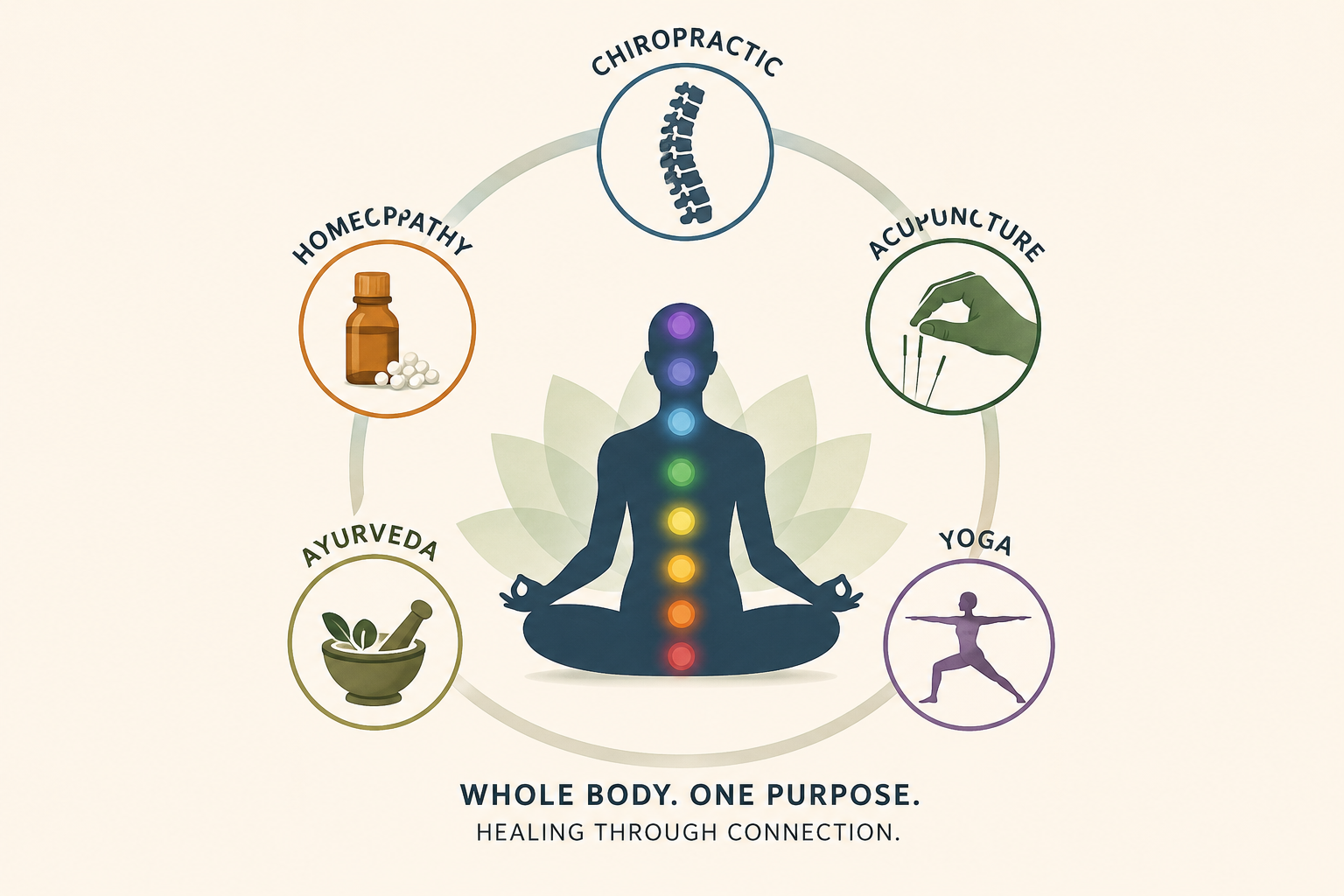
Chiropractic, acupuncture, yoga, Ayurveda and homeopathy are very different systems. They have different histories, different methods and different levels of scientific evidence. Yet, despite these differences, they share one broad idea: the body functions best when there is connection, communication, rhythm and flow.
In chiropractic, this may involve spinal movement, joint function, muscle tone, nervous system input and body awareness. In acupuncture, this is traditionally described through meridians and the flow of qi. In yoga, the focus may be on breath, posture, prana, awareness and the energy centres known as chakras. Ayurveda looks at balance, constitution, digestion, daily routine and harmony with natural rhythm. Homeopathy, while more controversial, places emphasis on the individual symptom picture and the person as a whole.
These systems should not be blurred together carelessly. Meridians are not simply nerves. Chakras are not anatomical organs. Qi and prana are not measured in the same way as blood pressure, heart rate or oxygen levels. However, these traditions use different languages to point toward a similar observation: when the body becomes blocked, tense, overloaded, disconnected or out of rhythm, wellbeing often suffers.
Chiropractic: The Spine, Movement and the Nervous System
Chiropractic is a modern healthcare profession, but it shares a whole-body philosophy with many older healing traditions. The spine is not just a stack of bones. It is a living, moving structure surrounded by muscles, ligaments, joints, discs, connective tissue, blood vessels and nerves.
The spinal cord travels through the spine, while spinal nerves pass between the vertebrae and communicate with muscles, joints, skin and other areas of the body. Because of this, the spine is deeply connected to movement, posture, balance, pain perception and body awareness.
When spinal joints are stiff, irritated or poorly controlled, the body may respond with muscle guarding, altered movement, discomfort and increased sensitivity. A chiropractic adjustment is not simply about creating a click. The click is only the sound. The deeper value lies in how the body responds to a controlled input into the joints, muscles and nervous system.
After an adjustment, some patients may feel looser, lighter, more upright or more aware of their body. This does not mean the body has magically changed in one moment. Rather, the nervous system may be receiving different information, movement may feel easier, and muscle guarding may reduce.
This is why chiropractic care should not be viewed only as a mechanical treatment. It is also about communication. The body sends information to the brain, the brain responds, movement changes, tension changes and awareness changes. That is what happens beyond the click.
Acupuncture: Meridians and the Flow of Qi
Acupuncture comes from Traditional Chinese Medicine and uses a very different map of the body. Rather than focusing mainly on joints, muscles and nerves, acupuncture speaks about meridians. These are traditionally understood as pathways through which qi, or vital energy, flows.
When qi is considered blocked, deficient or imbalanced, symptoms may develop. Acupuncture aims to influence this flow by stimulating specific points on the body, usually with fine needles.
From a modern scientific viewpoint, meridians are not described in the same way as nerves, arteries or lymph vessels. Therefore, it would be inaccurate to say they are exactly the same thing. However, acupuncture points are often located in areas rich in connective tissue, nerve endings and muscular structures, and modern research continues to explore how acupuncture may influence pain, nervous system activity, local tissue response and the body’s internal regulation.
The language is different, but the principle is still interesting. Acupuncture recognises that the body responds to input, that one area of the body may influence another, and that pain or dysfunction may reflect a deeper disturbance in the body’s balance. This whole-body view is one reason acupuncture has remained part of traditional healthcare for thousands of years.
Yoga: Breath, Posture, Chakras and Awareness
Yoga is often misunderstood as stretching, but traditional yoga is much broader. It includes posture, breathing, concentration, meditation, discipline, self-awareness and lifestyle. At its heart, yoga teaches that the body, breath and mind are connected.
When stress increases, breathing often becomes shallow. When breathing becomes shallow, posture may change. When posture changes, muscle tension may increase. As muscle tension increases, the body may feel more threatened, guarded and uncomfortable. Therefore, yoga does not only ask the body to move; it asks the person to notice.
This is a powerful idea because many people today are disconnected from their bodies. They only notice the body when pain becomes loud enough to interrupt their life. Yoga invites the person to ask: how am I breathing, where am I holding tension, am I present in my body, and am I forcing movement or listening to it?
Yoga philosophy also speaks about chakras. Chakras are traditionally described as centres of energy and awareness along the central axis of the body, often linked with physical, emotional and spiritual themes. For example, some traditions associate the lower chakras with grounding and survival, the heart chakra with connection, and the upper chakras with expression, insight and awareness.
From a modern anatomical perspective, chakras are not organs like the heart, lungs or liver. However, as a symbolic and reflective model, the chakra system may encourage people to think about how posture, breath, emotion, stress and awareness are held in the body. This does not need to be dismissed simply because it uses a different language. It can be understood as a traditional way of exploring the relationship between the body, mind and human experience.
Ayurveda: Balance, Rhythm and Daily Life
Ayurveda is a traditional Indian system of health that focuses on balance, constitution, digestion, lifestyle, rhythm and harmony with nature. Where modern healthcare often asks, “What symptom do you have?” Ayurveda tends to ask broader questions about how a person lives.
How do you eat? How do you sleep? How do you digest food? What is your daily rhythm? How do you respond to stress? What habits are pushing your body toward or away from balance?
This type of questioning is extremely relevant today. Many people live in a way that constantly works against the body. They sit for long hours, move too little, eat processed foods, sleep late, use screens at night, live under constant stress, rarely get sunlight and ignore pain until it becomes severe.
Then, when symptoms appear, they are often told to simply take medication. Yet in many cases, the body is not failing randomly. It is responding logically to an unnatural lifestyle.
Ayurveda reminds us that daily rhythm matters. Food matters. Sleep matters. Movement matters. Morning light matters. Digestion matters. Emotional state matters. Rest matters. This does not mean every Ayurvedic product is automatically safe or effective, because natural does not always mean safe. However, the broader principle is valuable: health is built through daily habits, not only through treatment after symptoms appear.
Homeopathy: Whole-Person Care and Scientific Debate
Homeopathy is one of the most debated healing systems. It was developed more than 200 years ago and is based on the principle of “like cures like.” In simple terms, this means that a substance that may cause symptoms in a healthy person is believed, in highly diluted form, to help someone with a similar symptom pattern.
Homeopathy also places strong focus on the whole person. A consultation may explore physical symptoms, emotional state, sleep, temperature sensitivity, personality traits, fears, cravings and general wellbeing. Many patients appreciate this because they feel heard as a person, not treated as a diagnosis.
However, we also need to be honest. Homeopathy has weaker scientific support than many other approaches and remains controversial, especially when claims are made about treating serious disease. For that reason, homeopathy should not replace appropriate medical investigation or urgent care when these are needed.
At the same time, the whole-person consultation style does raise an important point. Patients often want to be listened to. They want someone to ask about their sleep, stress, lifestyle, emotions, fears, pain patterns and daily reality. That should not be considered alternative. That should be basic healthcare.
Cerebrospinal Fluid, the Spine and the Importance of Flow
The idea of flow appears in many healing traditions. Acupuncture speaks about the flow of qi, yoga speaks about prana and breath, Ayurveda speaks about rhythm and balance, and chiropractic speaks about movement, nervous system communication and the relationship between the spine and body function.
Modern anatomy also gives us a real biological example of flow: cerebrospinal fluid, or CSF. CSF is the fluid that surrounds and protects the brain and spinal cord. It cushions the central nervous system and helps maintain the environment around the brain and spinal cord.
The brain and spine are not static structures. They exist within a living, moving, fluid system. Breathing, sleep, posture, movement and nervous system activity all form part of the body’s internal rhythm.
This is where the concept becomes fascinating. Ancient traditions may have spoken about energy flow, breath, prana or life force. Modern physiology speaks about fluids, pressure gradients, circulation, nervous system regulation and biological rhythm. The language is different, but the deeper observation remains interesting: the body depends on movement and flow.
However, we must be careful not to overstate the claim. It would be too strong to say that a chiropractic adjustment directly pumps CSF through the spine. A more responsible view is that the spine, breath, sleep, movement and nervous system are all connected to the body’s internal rhythms. Chiropractic care may influence movement, comfort, muscle tone, posture and body awareness, while CSF flow remains part of the body’s broader fluid system.
Whole-Body Healing Versus Symptom Suppression
This is where the conversation becomes important. Many people today are not suffering because they have a shortage of medication. They are suffering because their bodies are overloaded, under-rested, under-moved, poorly nourished and disconnected from natural rhythm.
They sit all day, stare at screens, rush through meals, ignore pain, suppress symptoms and keep going until the body forces them to stop. Then, too often, the answer becomes another pill: pain medication for pain, sleeping tablets for sleep, anti-inflammatories for inflammation, muscle relaxants for tension, antacids for digestion and stimulants for fatigue.
Again, medication may have its place. In some cases, it is necessary and life-saving. But chronic medication without addressing the cause can become a trap. If the lifestyle remains the same, the stress remains the same, the movement remains poor, the sleep remains broken and the body remains overloaded, then the symptom may simply return in another form.
Whole-body care asks deeper questions. Why is the pain there? Why is the body tense? Why is sleep poor? Why is inflammation persistent? Why is posture collapsing? Why is the nervous system constantly alert? Why has the person lost connection with their own body?
These are the questions that matter.
What These Traditions Have in Common
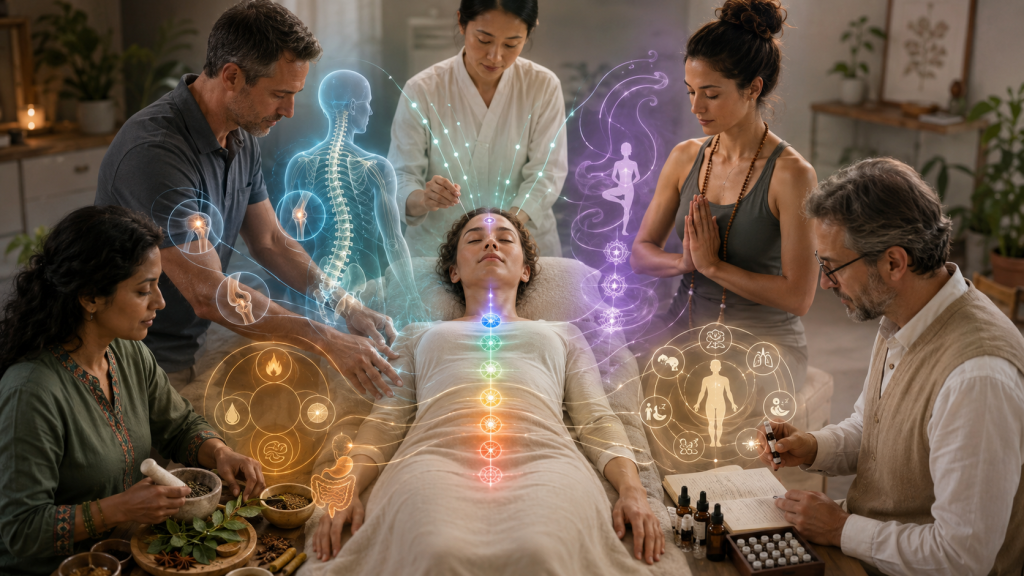
Although chiropractic, acupuncture, yoga, Ayurveda and homeopathy differ greatly, they share some important themes. Firstly, they look beyond isolated symptoms and recognise that the body works as a connected system.
Secondly, they understand that flow matters. That may mean spinal movement, nervous system input, qi, prana, breath, circulation, digestion, rhythm or awareness.
Thirdly, they encourage the patient to participate in healing. This is important because healing is not only something done to the patient. It is also something the patient participates in through movement, rest, food, breathing, sleep, posture, mindset and daily choices.
Finally, these traditions remind us that the body has wisdom. Pain is not always the enemy. Sometimes pain is information. Stiffness is information. Fatigue is information. Poor sleep is information. Tension is information. The goal is not always to silence the body as quickly as possible. Sometimes the goal is to listen.
Where These Traditions Differ
The similarities are interesting, but the differences also matter. Chiropractic focuses mainly on the spine, joints, muscles, movement and nervous system. It uses clinical examination, manual care, exercise advice and movement-based reasoning.
Acupuncture uses the traditional meridian model and specific points to influence qi and body function, while modern explanations may also involve the nervous system and pain modulation. Yoga uses posture, breath, awareness, meditation and discipline to influence the body and mind.
Ayurveda focuses on constitution, digestion, rhythm, food, lifestyle and balance. Homeopathy uses highly diluted remedies and individual symptom patterns, but remains scientifically controversial.
These systems should not be blended carelessly. Respecting ancient traditions does not mean accepting every claim without question. At the same time, demanding that every traditional idea must fit neatly into modern pharmaceutical thinking also misses the point. Different systems may offer different insights, and the responsibility is to remain honest, safe and patient-centred.
A More Honest Way Forward
Healthcare should not be controlled by profit. It should not be driven mainly by the long-term management of symptoms while the underlying causes are ignored, and it should not reduce human beings to prescriptions, lab numbers or diagnostic labels.
However, we should not reject useful modern advances either. Surgery can save lives. Emergency medicine can save lives. Antibiotics can save lives. Diagnostics can reveal serious disease. Medication can be necessary.
The problem is not medicine itself. The problem is a model of healthcare that too often waits for people to become sick, then manages the symptoms without teaching them how to rebuild health.
A better model would combine the best of both worlds: modern diagnostics where needed, emergency care when necessary, manual care where appropriate, movement and rehabilitation, nutrition and lifestyle support, sleep and stress regulation, breath and body awareness, patient education, prevention and personal responsibility.
This is not alternative thinking. This is common sense.
Bringing It Back to the Patient
For the patient, the most important question is not which system has the oldest tradition or the strongest philosophy. The better question is: what does my body need now?
Does it need better movement, rest, strength, sleep, less stress, improved posture, better breathing, medical investigation, hands-on care or a change in daily habits? Often, the answer is not one thing.
A patient with back pain may need chiropractic care, exercise, better sitting habits, improved sleep and less stress. A patient with headaches may need neck assessment, hydration, jaw evaluation, eye testing, posture correction, breathing awareness or medical referral. A patient with chronic tension may need muscle work, movement, rest and a better understanding of how stress is being held in the body.
This is what whole-body care means. It is not about choosing one system and rejecting everything else. It is about asking better questions.
Final Thoughts
Chiropractic, acupuncture, yoga, Ayurveda and homeopathy are not the same. They come from different cultures, histories and models of health. Some are more supported by modern research than others. Some use symbolic language, some use physical treatment, some focus on lifestyle and some remain controversial.
However, they all remind us of one powerful truth: the body is connected.
Movement matters. Breath matters. Sleep matters. Stress matters. Posture matters. Nutrition matters. Awareness matters. The nervous system matters. The patient’s lived experience matters.
Modern healthcare is strongest when it respects the whole person, not only the symptom. Ancient traditions may not provide every answer, but they do ask an important question: are we treating the body as a living, connected system, or are we simply suppressing the warning signs?
Reconnect With Your Body
Your body is always communicating through pain, stiffness, fatigue, posture, breathing, movement and tension. Chiropractic care offers one way to explore that communication through the spine, joints, muscles and nervous system.
If you are ready to explore a whole-body approach to movement, pain and wellbeing, visit Dr Ron Van As online to learn more or book your appointment.
Educational Disclaimer
This article is for general educational purposes only. It does not provide a diagnosis, replace a physical examination or substitute for medical care.
If you have severe pain, progressive symptoms, neurological signs, unexplained weight loss, fever, trauma, chest pain or any urgent health concern, please seek appropriate medical attention.