Many years ago, while I was working in Malaysia, an eight-year-old girl was brought into my clinic by her parents.
She was sitting in a wheelchair.
Some time earlier, she had suffered a near-drowning accident after falling into a swimming pool. Although she survived, the lack of oxygen had caused severe neurological injury. Her movement was badly affected, she had extreme difficulty walking, and the clinical findings were consistent with significant upper motor neurone dysfunction.
Before coming to see me, her parents had taken her to a neurosurgeon. After assessing her condition, he had apparently told them that she would most likely remain in a wheelchair for the rest of her life.
It was a devastating prognosis, but not necessarily an unreasonable one.
This little girl had sustained a serious injury. She could not walk safely or independently, and the wheelchair offered protection, mobility and a practical way for her parents to care for her. From a medical and logistical perspective, the recommendation made sense.
Yet, as I watched her sitting there, something about the situation bothered me.
It was not that I believed the neurosurgeon had made the wrong diagnosis. I did not possess some secret knowledge that everyone else had missed, nor did I imagine that a few treatments would somehow reverse the damage caused by the accident.
My concern was more fundamental.
She was only eight years old.
If the wheelchair became her permanent answer from that moment onwards, she might gradually stop attempting to move altogether. Her muscles would become weaker, her coordination would receive less stimulation, and she could become increasingly dependent on her parents for almost every part of daily life.
The wheelchair might help her move around, but it could also quietly remove many of the reasons she had to keep trying to move herself.
I had a strong feeling that we should not give up on her movement simply because walking was difficult.
So, I suggested something that initially sounded completely bizarre to her parents.
Take her out of the wheelchair.
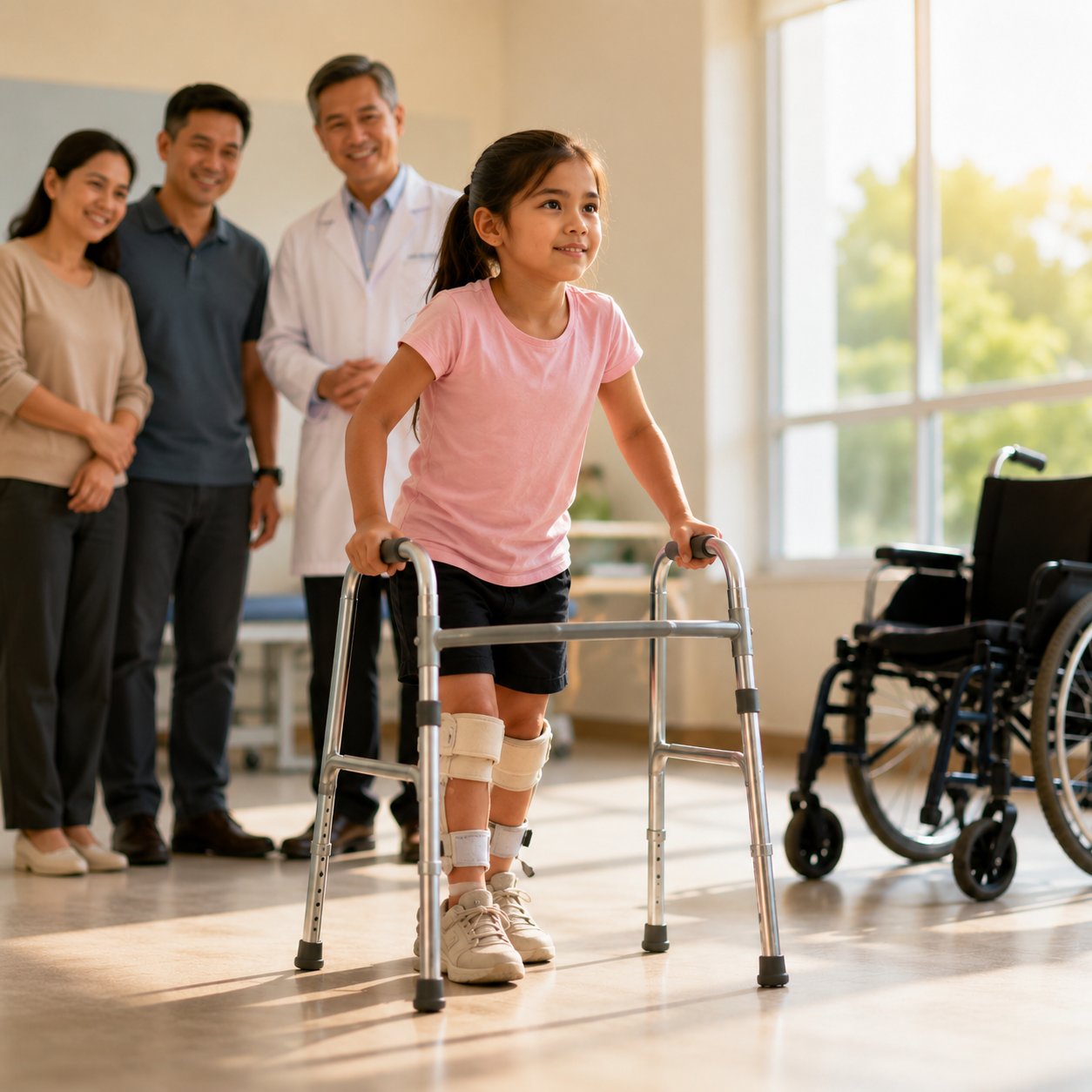
Not recklessly, of course. She still required support and supervision, and nobody was suggesting that she should simply be placed on her feet and told to get on with it. However, instead of allowing the wheelchair to become her only form of mobility, I suggested that she should be encouraged to crawl, pull herself up, practise supported movement and, when possible, begin using a walker.
Her parents looked at me as though I had temporarily misplaced my professional judgement.
They had just been told by a neurosurgeon that their daughter would probably spend the rest of her life in a wheelchair. Now a chiropractor was suggesting that they take her out of it and encourage her to crawl around the house.
I could understand their reaction.
I also understood the risk of giving them false hope. I was sceptical that she would ever walk normally again, and I made no promises that she would. The neurological damage was real, and determination alone does not magically erase serious injury.
However, there is an important difference between promising recovery and creating an opportunity for improvement.
My reasoning was simple: if she was able to move, even slowly and awkwardly, then that movement was worth preserving. If she could crawl, we should allow her to crawl. If she could stand with assistance, we should help her stand. If she could take steps with a walker, we should encourage those steps.
The goal was not perfection.
The goal was independence.
To their enormous credit, her parents listened.
They gradually exchanged the wheelchair for a walker and began encouraging her to move. It was difficult in the beginning. She was slow, unstable and understandably frustrated. Progress did not arrive in one dramatic moment accompanied by inspirational music and a conveniently placed television camera.
It arrived in small, exhausting increments.
A little more balance.
A little more confidence.
A few more steps.
Slightly less assistance.
Each time she returned to my clinic, I could see a difference. She was still impaired and still required help, but she was improving. She was becoming more capable, more mobile and less dependent on the wheelchair.
Then came the visit I have never forgotten.
She walked into my clinic using her walker.
She was not walking normally. She had not experienced a miraculous cure, and I would never want the story to be interpreted that way. She had suffered a serious neurological injury and continued to live with its consequences.
But she walked into the clinic herself.
Slowly, awkwardly and with great effort—but independently.
I had to fight back tears.
In that moment, I realised that I had not necessarily given her a cure. What I had given her was an alternative possibility.
I had given her hope.
That does not mean the neurosurgeon was wrong. In fact, based on the severity of her condition, his opinion may have been entirely reasonable. He was working from his training, his experience and the information available to him. Most practitioners faced with the same circumstances might have reached a similar conclusion.
The difference was not that one of us understood the diagnosis and the other did not.
The difference was in the question we were asking.
The neurosurgeon was considering what her likely long-term disability would be.
I was asking what ability she still had—and how much of it might be preserved or developed if she continued trying to move.
Both questions mattered.
This experience taught me something that has remained with me throughout my career: a prognosis should guide us, but it should not always become a prison sentence.
There are moments when clinical evidence gives us a clear answer. There are also moments when the evidence tells us what is probable but cannot tell us what is possible for one particular human being.
That is where judgement, curiosity and courage become important.
Following your instinct does not mean ignoring science, dismissing specialists or pretending that positive thinking can overcome every disease. It means being willing to look at a problem from another angle, particularly when the conventional answer removes all possibility of progress.
Sometimes the safest decision is to protect someone from failure.
Sometimes the more meaningful decision is to give them a carefully supported opportunity to try.
The human body has an extraordinary ability to adapt. It does not always heal in the way we want, and it certainly does not respond to motivational slogans or wishful thinking. Yet, when given movement, repetition, encouragement and time, it can sometimes develop abilities that were not initially expected.
The little girl did the difficult work. Her parents supported her every day. Other healthcare professionals may also have contributed to her rehabilitation. I merely asked a different question at a moment when everyone seemed to have accepted the answer.
What can she still do?
That question changed the direction of her life.
Perhaps it is a question we should ask more often—not only in healthcare, but in our own lives.
When something goes wrong, we are often quick to focus on what has been lost. We accept the label, the prediction or the limitation and begin organising our future around it.
Sometimes that is necessary.
But sometimes we need to pause, look again and ask whether there is another path.
Not a guaranteed path.
Not an easy path.
Just a path that leaves enough room for hope.
Sometimes the most important question is not “What has been lost?” but “What is still possible?”
This story stayed with me because it reminded me that careful clinical judgement, movement, patience and hope can sometimes open a path that nobody expected.
If this story made you question an assumption in your own life, share it with someone who may need that reminder today.
For more stories about health, human resilience and the questions we do not ask often enough, visit drronvanas.com.
This story is shared without identifying details. It describes one patient’s experience and should not be interpreted as a promise of recovery, a criticism of specialist care or a recommendation to discontinue medically necessary mobility aids. Decisions involving neurological injury and rehabilitation require individual assessment, appropriate supervision and coordinated professional care.