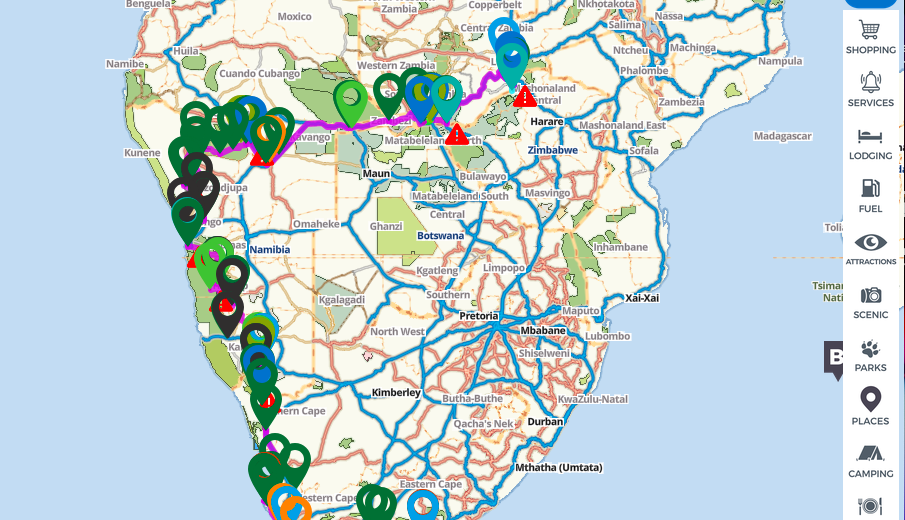

Botswana & Namibia Food Rules for Overlanders — Updated August 2026
One of the surprisingly complicated parts of planning Travels with Tau has nothing to do with fuel range, tyre pressures, recovery equipment or finding a campsite. It is the Namibia and Botswana food border rules.
Can I take meat across the border? What about chicken? Eggs? Milk? Cheese? Biltong? Fruit and vegetables?
Ask ten overlanders and you may get ten different answers.
Some travellers report crossing a border with a fully stocked fridge without any problem. Others have arrived at exactly the same border with vacuum-packed meat bought from a supermarket and had hundreds or even thousands of rand or kwacha worth of food confiscated.
So who is right?
Unfortunately, sometimes both of them are.
That is because food restrictions across Southern African borders are affected by veterinary disease outbreaks, particularly Foot and Mouth Disease (FMD), as well as customs, agricultural and plant-health regulations. Those restrictions can change quickly.
For our Travels with Tau journey from Zambia through Botswana and Namibia, I wanted something better than Facebook rumours. I therefore went back to official Botswana and Namibian government and veterinary sources to establish what the rules currently say.
IMPORTANT — PLEASE READ THIS FIRST
This article reflects official information available on 26 August 2026.
Veterinary and agricultural restrictions can change with very little notice, particularly during outbreaks of Foot and Mouth Disease, African Swine Fever, avian influenza and other animal diseases.
Botswana’s own customs authority specifically warns that restrictions on agricultural goods can change “in a very short time” and advises travellers to confirm current requirements before travelling.
This article should therefore be used as a planning guide, not as a guarantee that a particular food product will be admitted on the day you arrive at the border.
My advice is simple: check again shortly before travelling and declare food when crossing the border.
Why Is There So Much Confusion?
Part of the problem is that there isn’t just one set of rules.
There can effectively be three layers:
- Customs rules — how much of a product may normally be brought into the country for personal use.
- Veterinary regulations — restrictions designed to stop animal diseases crossing borders.
- Internal veterinary control zones — restrictions on moving products from one part of a country to another.
And this creates one of the biggest misunderstandings among travellers:
A customs allowance does not necessarily mean the product may be brought across the border today.
Botswana is a good example.
Botswana Unified Revenue Service currently publishes normal private-use allowances including:
- Red meat, goat or lamb — up to 25 kg per family
- Poultry — 5 kg per person
- Eggs — 36 per person
- Fresh milk — 2 litres per person
- Various quantities of vegetables, grains and other foodstuffs
Those are genuine official allowances.
But veterinary disease restrictions can override them.
And in 2026, that distinction matters enormously.
Botswana and Foot and Mouth Disease in 2026
Botswana has been dealing with significant FMD outbreaks during 2026.
Although vaccination programmes have made progress in some areas, the FMD situation was still active in August 2026. On 18 August, Botswana’s Department of Veterinary Services reported that cases were declining but that disease-control measures and vaccination programmes remained underway.
Different veterinary zones have also been subject to different movement restrictions at different times.
This means we cannot simply print out the normal BURS allowance of 25 kg of meat per family, wave it at the border official and assume our steaks are safe.
Zambia Into Botswana: What Will I Do With Tau?
Our journey begins in Zambia, so one of my first food decisions is what I should load into Tau before crossing at Kazungula.
My conclusion after researching the current regulations is:
I am not going to fill Tau’s freezer with red meat in Lusaka.
That means I would avoid trying to cross into Botswana carrying substantial quantities of:
- Beef
- Lamb
- Goat
- Pork
- Game meat
- Raw boerewors
- Raw bacon
- Mince
- Steaks and chops
Could some of those foods theoretically be permitted under normal import allowances?
Yes.
Would I gamble an expensive fridge-full of meat on that when veterinary controls can override normal customs allowances?
No.
Kasane has supermarkets.
It makes much more sense to cross the border with relatively little fresh animal product and restock once we are inside Botswana.
“But Mine Is Vacuum Packed”
This is another common argument.
Vacuum packing is excellent for overlanding because it keeps meat organised, reduces contamination and dramatically improves fridge and freezer storage.
But vacuum packing does not automatically make meat acceptable under veterinary disease-control rules.
Botswana’s 2026 FMD guidance specifically distinguishes genuinely processed products from fresh animal products.
The important principle for us is:
Packaging and processing are not the same thing.
Frozen steak is still raw steak.
Vacuum-packed boerewors is still raw meat.
A very expensive label from a premium supermarket does not change its veterinary status.
What About Milk?
Here there is a useful distinction.
During Botswana’s current FMD controls, officials have specifically identified products such as:
- UHT milk
- Pasteurised milk
- Sour milk
- Certain cooked products
as products that are not treated in the same way as fresh cloven-hoofed meat and fresh milk when moving through FMD control zones.
For overlanding, this strengthens the case for carrying UHT milk rather than relying on fresh milk.
It also has the considerable advantage of not occupying precious fridge space until opened.
What About Biltong?
This becomes more complicated.
Properly processed and thoroughly dried meat can be treated differently from raw meat under some veterinary controls.
But I would be extremely cautious about assuming that all biltong and droëwors are automatically allowed across an international border.
There is a huge difference between very dry, properly processed meat and moist biltong that is essentially cured meat that still contains substantial moisture.
My rule for Tau will therefore be:
If I am unsure, declare it.
Losing a packet of biltong is irritating.
Losing half the contents of the fridge because I assumed everything was legal is considerably worse.
Fruit and Vegetables Into Botswana
Fruit and vegetables are generally less problematic than raw animal products, although agricultural controls still exist.
Botswana’s normal private-use allowances include products such as potatoes, onions, tomatoes, oranges, cabbage, spinach and various grains and pulses.
However, plants, seeds, soil and planting material fall into a different category because of plant-health and biosecurity rules.
For our trip, basic vegetables and dry groceries are therefore far less concerning than filling the freezer with meat.
Then We Reach the Botswana–Namibia Border

This is where I intend to become considerably more conservative.
Namibia imposed restrictions in March 2026 on the importation and transit of cloven-hoofed animals and their products from Botswana following FMD concerns.
As of my research on 26 August 2026, I have not found a later official notice cancelling that Botswana-related restriction.
That could change before we travel.
But based on the information available now, I would not approach the Namibia border from Botswana with Tau’s freezer packed with beef, lamb, pork, goat or game meat.
My Botswana-to-Namibia Strategy
Before entering Namibia I intend to eat down the contents of the fridge and freezer.
Rather than doing a huge meat and grocery shop in Kasane before crossing the border, I would rather cross first and then restock in Namibia.
That means approaching the border with relatively little:
- Beef
- Lamb
- Goat
- Pork
- Raw game meat
- Boerewors
- Fresh dairy
- Eggs
- Other questionable animal products
It may feel strange deliberately running the fridge down when travelling into a remote country.
But financially it makes sense.
There is no advantage in buying several days of expensive meat only to watch it disappear into a confiscation bin at the border.
Be Careful With Old Internet Advice About Chicken
This is another reason I have become wary of generic internet lists.
You will find older information online referring to a 5 kg personal-use poultry allowance for Namibia.
However, Namibia’s Livestock and Livestock Products Board published a notice in April 2026 concerning the repeal of Government Notice No. 54 of 28 February 2020, which was connected with the previous poultry import regime.
Therefore I would not rely on old websites, Facebook posts or forum comments quoting the former 5 kg rule.
Chicken may be treated differently from cloven-hoofed meat under FMD controls, but current international import rules still need to be checked before crossing.
This perfectly demonstrates why food regulations need to be checked shortly before departure.
Namibia Has Another Surprise: The Veterinary Cordon Fence
Successfully entering Namibia does not mean the food issue is finished.
Namibia has an internal Veterinary Cordon Fence, commonly called the Red Line, separating the northern parts of Namibia from the officially recognised FMD-free zone farther south.
It separates the northern FMD protection/infected areas from Namibia’s FMD-free commercial farming zone to the south. Official Namibian material describes the fence as running for roughly 1,250 km from the Palmgrave/Palmwag area in the west across northern Namibia toward the Botswana side in the east.
And this becomes extremely important for our route.
On our planned route, the important checkpoint will be the Mururani veterinary gate on the B8 between Rundu and Grootfontein. Before reaching that gate, I intend to run Tau’s fridge down and avoid carrying raw beef, lamb, pork, goat or game meat south through the veterinary cordon. Once we are through the checkpoint and into Namibia’s FMD-free zone, we can restock farther south.
Can Frozen Meat Cross the Red Line?
This is one of the most useful answers I found.
No — freezing raw meat does not make it safe for movement through an FMD-controlled veterinary boundary.
Namibia’s Directorate of Veterinary Services specifically explains that FMD virus can survive in animal tissue, including after the meat has been frozen.
So:
Frozen beef is still raw beef.
Vacuum-packed steak is still raw meat.
Frozen boerewors is still a raw cloven-hoofed animal product.
Putting meat into an expensive Engel or National Luna freezer does not transform its veterinary status.
What Can Move South Through Namibia’s Veterinary Fence?
Namibia’s Directorate of Veterinary Services provides some useful distinctions.
It states that dried meat from cloven-hoofed animals may enter the FMD-free zone without a veterinary permit when all portions are cooked and free from blood.
It also states that products from non-cloven-hoofed animals such as:
- Chicken
- Fish
- Donkey
- Horse
may move into the FMD-free zone.
Plants and plant products may also move provided they are not contaminated with material such as manure from cloven-hoofed animals.
This has a direct influence on how I intend to plan food for Tau.
The Travels with Tau Food Plan
For our particular route, this is the strategy I currently intend to follow.
| Part of the journey | My food strategy |
|---|---|
| Lusaka → Kazungula | Carry dry groceries and limited questionable fresh animal products. Don’t fill the freezer with red meat. |
| Entering Botswana | Declare food and restock after crossing. |
| Travelling through Botswana | Buy locally and remain aware of internal veterinary control zones. |
| Before entering Namibia | Eat down the fridge/freezer rather than doing a big meat shop in Kasane. |
| Entering Namibia | Cross with minimal raw animal products and declare what remains. |
| Northern Namibia | Buy according to what we need rather than stocking the freezer for the entire Namibian journey. |
| Before crossing south through the Veterinary Cordon Fence | Finish restricted raw cloven-hoofed meat. |
| South of the veterinary fence | Restock for the southern Namibia portion of the expedition. |
This will require slightly more shopping along the way.
But I would rather spend twenty minutes in a supermarket than throw several days’ worth of food into a border-post bin.
Four Border Myths That Could Become Expensive
“It’s frozen, so it is allowed.”
Not necessarily.
Freezing does not eliminate the veterinary concerns associated with FMD. Namibia’s DVS specifically warns that the virus can survive in frozen animal tissues.
“It’s vacuum packed.”
That makes it excellent for your fridge.
It does not automatically make it legally processed for veterinary purposes.
“I bought it from a supermarket.”
That demonstrates where you bought it.
It does not override an animal-health movement restriction.
“The official website says I can bring 25 kg of meat into Botswana.”
Under Botswana’s normal private-use customs rules, that allowance does exist.
But veterinary emergency restrictions can be imposed separately.
That is why both statements can be true at the same time.
Declare Rather Than Hide
I think this is one of the most important lessons.
If I am carrying food that may be controlled, I would rather tell the veterinary or customs official what is in the fridge.
Trying to conceal meat beneath other food is not clever overlanding.
At best it creates an unpleasant border crossing.
At worst it could create a legal problem.
The people operating veterinary checkpoints are not trying to ruin our braai. Their job is to prevent diseases capable of causing enormous losses to livestock farmers and national agricultural industries.
We may not always enjoy the inconvenience, but there is a genuine reason those controls exist.
Check Again Before You Travel
Perhaps the most important information in this entire article is this:
Do not print this article today and treat it as the law six months from now.
Botswana itself warns that restrictions on agricultural goods can change at very short notice.
FMD outbreaks can result in new veterinary zones, movement restrictions and border controls being introduced rapidly.
The same applies to:
- African Swine Fever
- Avian influenza
- Newcastle disease
- Plant diseases and pests
- Other veterinary outbreaks
Before Travels with Tau leaves Zambia, I will therefore check the rules again.
I will also check them before crossing from Botswana into Namibia, because the situation may have changed while we are already travelling.
Where Should You Check?
For Botswana, use information from:
- Botswana Unified Revenue Service (BURS)
- Botswana Department of Veterinary Services
- Botswana Ministry responsible for agriculture
- Officials at the relevant border post
Botswana’s BURS guidance itself tells travellers who are unsure about restricted agricultural goods to contact Customs before travelling.
For Namibia, check:
- Directorate of Veterinary Services
- Ministry responsible for agriculture
- Livestock and Livestock Products Board of Namibia
- Officials at your intended border crossing
The Livestock and Livestock Products Board publishes border-control information and contact details for border posts including Katima Mulilo and Buitepos.
My Advice to Fellow Overlanders
The simplest strategy may also be the best:
Don’t carry your entire holiday’s food across international borders.
Carry:
- Dry groceries
- Shelf-stable food
- Tinned products
- Water
- Basic supplies
- Enough food to get comfortably to the next shopping opportunity
Then buy fresh meat, dairy and vegetables after crossing the border whenever practical.
Southern Africa has supermarkets.
You don’t need to transport four weeks of boerewors from home.
And if your route crosses veterinary control zones, plan your shopping around those zones rather than fighting against them.
Preparation Is About More Than Packing
One of the things this journey continues to teach me is that overlanding preparation isn’t simply about adding more equipment to Tau.
Sometimes good preparation means carrying less.
Knowing where the veterinary boundaries are, understanding what might be confiscated and planning where to restock may ultimately save more money and frustration than another piece of expensive overlanding equipment.
This is exactly why I started planning the route before planning what to pack.
[Read my previous Travels with Tau article about route planning here.]
[Read my previous Travels With Tau article about border crossings here.]
Join my Facebook group “Travels With Tau”
As we get closer to departure, I will update these food regulations again and share any changes I find.
Because when it comes to African border crossings, today’s perfectly legal braai pack can potentially become tomorrow’s very expensive donation to the confiscation bin.
Explore. Discover. Inspire.
Travels with Tau
Sources and update note
This article was researched using official information from Botswana Unified Revenue Service, the Government of Botswana and Department of Veterinary Services-related notices, Namibia’s Directorate of Veterinary Services, and the Livestock and Livestock Products Board of Namibia.
Information checked: 26 August 2026.
Regulations are subject to change. Travellers remain responsible for confirming current requirements with the appropriate border, customs and veterinary authorities before travelling.